Beats, Bronze, and Belonging: How Indonesian-American Producers Are Rewiring Gamelan for the Streaming Era
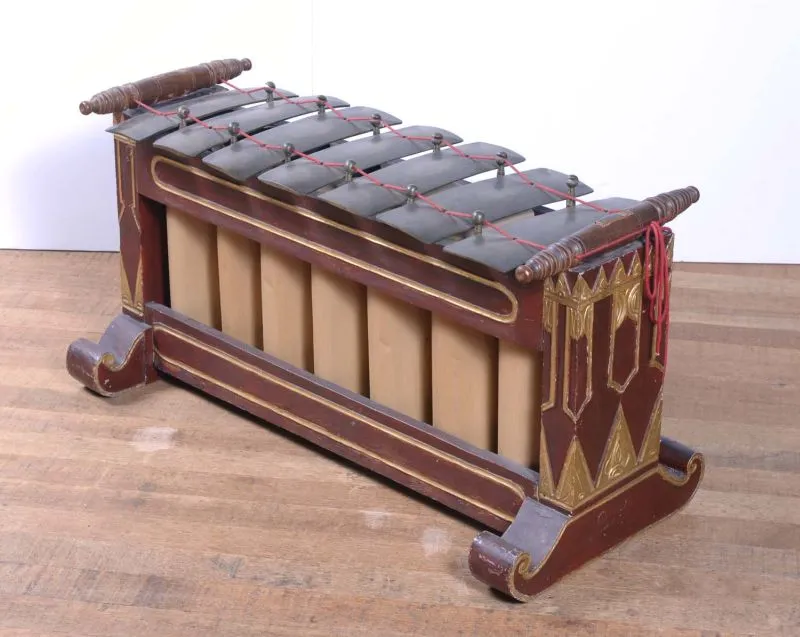
Photo: Tropenmuseum, CC BY-SA 3.0, via Wikimedia Commons
There's a moment in producer Dian Kusuma's home studio in Portland, Oregon, where the track shifts. What starts as a familiar lo-fi beat — the kind you'd find on any chill playlist — suddenly opens up into something else entirely. A metallic shimmer cuts through the mix, bright and resonant, like someone dropped a stone into still water. That's the bonang, a row of small gongs central to the Javanese gamelan ensemble. Dian recorded it during a visit to her grandmother's house in Surabaya three years ago. Now it lives inside a DAW, stretched and pitched and looped into something her grandmother probably wouldn't recognize — but might still feel.
"It's not about making gamelan cool," Dian says, laughing a little. "It's more like... I needed these sounds to exist in my life every day. And this is how I live my life."
She's not alone.
A New Sound With Old Roots
Across the US, a loose but growing network of Indonesian-American musicians and producers is doing something that doesn't fit neatly into any genre category. They're pulling from the gamelan tradition — those layered, interlocking percussion instruments made of bronze and bamboo, tuned to scales that don't map onto Western music theory — and weaving those textures into electronic production, indie rock, and hip-hop.
The results are genuinely hard to classify, which is probably the point.
In Los Angeles, a collective called Saron Sessions (named after the gamelan's xylophone-like saron instrument) has been hosting monthly listening parties where producers share work-in-progress tracks built around field recordings from Indonesian temples, markets, and family ceremonies. The vibe is part open mic, part cultural salon. Attendees skew young, many of them second-generation Indonesian-Americans who grew up hearing these sounds at home but never quite saw them reflected in the music they consumed.
"There's this gap," says Rizky Pratama, one of Saron Sessions' organizers and a producer who releases music under the name Kempul. "You grow up loving Kendrick or Bon Iver or whatever, and then you go to your uncle's house and there's gamelan playing and it feels like a completely different universe. I just got tired of those universes not talking to each other."
Streaming Is Opening Doors — Slowly
The commercial landscape for this kind of music is still pretty niche, and the artists involved are mostly honest about that. Spotify and Apple Music have made global distribution easier than ever, but algorithmic playlisting still tends to funnel listeners toward established genre categories. "World music" as a catch-all label has long frustrated artists who don't want their work exoticized or filed away somewhere listeners rarely browse.
Still, there are signs of momentum. A handful of tracks blending gamelan samples with electronic production have found traction on playlist communities organized around ambient music, lo-fi hip-hop, and experimental sound design. YouTube has been particularly useful — longer, more atmospheric pieces that might not fit radio formats can accumulate meaningful audiences there.
And TikTok, somewhat unexpectedly, has become a discovery tool. Short clips featuring gamelan-infused beats have pulled in curious listeners who had no prior connection to Indonesian music. Comments sections fill up with people asking "what is that sound?" — which, for artists like Dian and Rizky, is exactly the opening they want.
Preservation or Innovation? Why Not Both?
There's a real tension in this space, and the artists working in it are aware of it. Gamelan isn't just background texture — it's a sophisticated, deeply codified art form with regional variations across Java, Bali, and beyond. Pulling individual sounds out of that context and running them through Ableton raises legitimate questions about what gets lost in translation.
Some artists are navigating this carefully. Rizky has been studying gamelan formally through a community program in the Bay Area and says that understanding the musical logic behind the instrument has changed how he uses it. "When you know why the notes work the way they do, you make different choices," he says. "You're not just grabbing a cool sound. You're in conversation with something."
Others are less concerned with strict preservation and more interested in what the music becomes when it moves. For them, diaspora itself is a kind of transformation — you don't arrive somewhere new and stay exactly the same, and neither does culture.
This mirrors broader debates happening in Indonesian-American communities around food, language, and identity. Authenticity is a complicated concept when you're living between two worlds, shaped by both and belonging fully to neither.
What's Coming Next
The scene is still small enough that most of the key players know each other, at least loosely. But there's a sense that something is building. A few artists are working toward full-length releases. Saron Sessions is exploring a podcast format. And there are conversations happening about a collaborative compilation that would bring together Indonesian-American producers from different cities.
None of it is happening on a major label timeline or with significant industry backing. It's grassroots in the truest sense — people making music because they need to, sharing it because they want others to find it.
For Dian, that's fine. She's not in a hurry. She's got more field recordings to dig through, more tracks to build, more ways to figure out what it means to carry a culture forward when you're doing it one beat at a time.
"Gamelan has been changing for centuries," she points out. "People forget that. It's not frozen. It never was."
Maybe that's the most Indonesian thing about what these artists are doing — honoring something by letting it breathe.