Rooted, Not Borrowed: How Indonesian Spiritual Traditions Are Finding an Honest Home in American Wellness

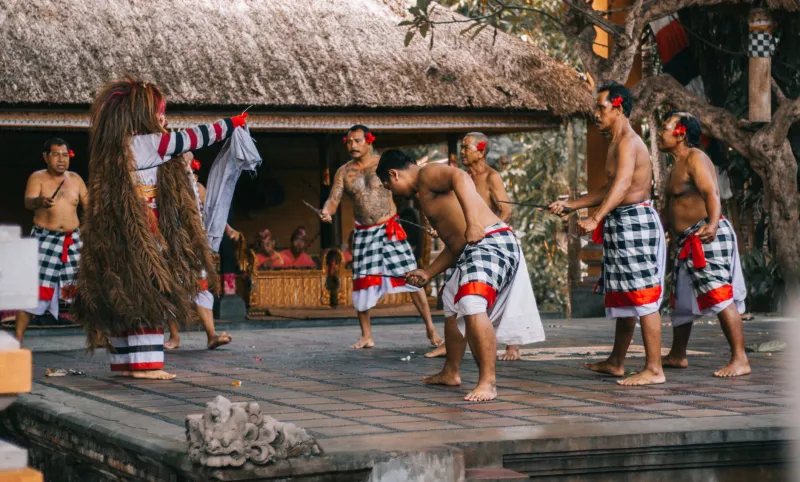
Photo by Photo by Karina Halley on Unsplash on Unsplash
The Wellness Aisle Has a Problem
Walk into any wellness boutique in Los Angeles, Austin, or Brooklyn right now and you'll find crystals pulled from unnamed traditions, breathwork marketed without a single mention of its origins, and "ancient healing" promises that conveniently forget to name the ancient culture doing the healing. American wellness has a long, complicated history of borrowing without asking.
So when Indonesian spiritual practices started appearing on the radar of American seekers—quietly, without a PR campaign—something felt different. The people introducing these traditions weren't wellness entrepreneurs looking for the next monetizable trend. They were Indonesian-Americans who grew up watching their grandmothers brew jamu in the kitchen, or who learned to meditate inside Javanese kejawen traditions long before meditation apps existed. And they came with boundaries.
"The first thing I tell anyone who comes to me curious about these practices is: slow down," says Ratih Kusuma, a Javanese-American healer based in Portland, Oregon who leads small-group sessions in traditional meditation rooted in kejawen philosophy. "There's no rush. These aren't techniques you download. They're relationships you build over time."
What We're Actually Talking About
Indonesian spiritual traditions are as diverse as the archipelago itself—over 17,000 islands, hundreds of ethnic groups, and a layered history that weaves together animist, Hindu, Buddhist, and Islamic influences into something genuinely distinct from any single one of those streams.
Kejawen, the spiritual tradition of the Javanese people, is one of the most widely practiced. It centers on inner stillness, harmony between the self and the cosmos, and a concept called rasa—a kind of deep inner feeling or knowing that can't be fully translated into English without losing something. Javanese meditation practices, sometimes called semedi or tapa, involve long periods of quiet contemplation, fasting, and attunement to natural rhythms.
Then there's jamu, the centuries-old Indonesian system of herbal medicine. Unlike the turmeric latte trend that swept American coffee shops a few years back, jamu is a living practice—a sophisticated system of plant-based remedies tailored to individual constitutions, seasons, and health needs. Real jamu isn't a single drink. It's a framework.
There's also a broader world of Indonesian energy work, some of it connected to practices like tenaga dalam (inner power cultivation), and traditional healing modalities tied to specific ethnic communities across Sumatra, Bali, Kalimantan, and beyond.
None of it fits neatly onto a wellness menu. And that's sort of the point.
The Gatekeepers Who Actually Know the Gate
What makes the current wave of Indonesian spiritual practice in America feel meaningfully different from the usual appropriation cycle is who's doing the teaching. These aren't outsiders who did a two-week retreat and came home with a certificate. They're practitioners with lineage—people who learned from family elders, community teachers, or long-term apprenticeships inside living traditions.
Dewi Hartanto, a jamu practitioner and herbalist in the San Francisco Bay Area, spent years studying alongside her mother and grandmother in Central Java before immigrating to the United States. She now offers one-on-one consultations and community workshops, but she's deliberate about the container she creates.
"I don't teach jamu as a recipe collection," she explains. "I teach it as a conversation—between you and your body, between you and the plants, between you and a tradition that has its own intelligence. That takes time to develop. I'm not going to hand someone a formula and send them home."
Her approach is increasingly common among Indonesian-American practitioners who've watched other cultural healing traditions get stripped of context and sold back to consumers at a markup. They're not interested in that pipeline.
For many of them, the work of cultural preservation and the work of responsible sharing are the same work. Keeping a tradition alive sometimes means opening the door carefully to people outside the community—but it always means holding the frame.
What American Seekers Are Actually Looking For
It would be easy to be cynical about the American wellness consumer. And sometimes, honestly, the cynicism is earned. But spend time in the spaces where Indonesian-American practitioners are doing this work, and you'll meet people who are genuinely tired of the commodified version of healing.
Many come from backgrounds in yoga or mindfulness who started asking harder questions—Where did this come from? Who taught the person who taught my teacher? What am I actually doing here? Others are burned out on the productivity-optimized wellness industrial complex and looking for something that doesn't feel like another form of self-improvement hustle.
Indonesian spiritual traditions offer something those seekers rarely find in mainstream wellness: a framework where the goal isn't optimization. It's keselarasan—harmony. With yourself, with others, with the natural world.
"Americans are often surprised that the point isn't to feel better in a measurable way," says Ratih. "The point is to be in right relationship. That's a different project entirely."
The Line Between Appreciation and Appropriation
It would be dishonest to pretend the line is always obvious. Indonesian-American practitioners themselves have ongoing conversations about when and how to share, who has the authority to teach what, and how to handle situations where their traditions are being misrepresented or commercialized without consent.
Some draw firm lines around sacred or initiation-based practices that simply aren't appropriate to share outside their original community contexts. Others are more open to cross-cultural exchange, provided it happens with transparency, proper attribution, and ongoing relationship—not a one-time transaction.
What most agree on is that the difference between appreciation and appropriation isn't just about who's doing the borrowing. It's about how. Is there acknowledgment of origin? Is the practitioner in relationship with the source community? Is there humility about what you don't know? Are the people who hold the tradition being centered, compensated, and credited?
Those questions don't have simple answers. But asking them seriously is already a meaningful departure from the way American wellness usually operates.
A Slower Kind of Wellness
There's no app for what Ratih and Dewi are offering. No subscription tier. No before-and-after transformation photo. And that's exactly what makes it interesting.
In a wellness landscape built on speed and scalability, Indonesian spiritual traditions insist on something slower and more demanding: genuine relationship with a living practice. That's harder to sell, which might be why it's survived centuries of colonial disruption and cultural pressure with its integrity more or less intact.
For Americans willing to slow down and approach these traditions with real respect, there's something genuinely nourishing here. Not as a product. As a practice.
And if that sounds less exciting than a weekend retreat with a certificate at the end—good. That's probably the first sign you're on the right track.