Bull Races, Batik Blocks, and a Town You've Never Heard Of — But Should
Most Americans who've heard of Indonesia think Bali first. Maybe Jakarta second. But spend five minutes in any Indonesian-American community center from Houston to Dearborn and you'll start hearing another name come up — Pamekasan. It's a regency on the island of Madura, connected to East Java by one of the longest bridges in Southeast Asia, and it's been quietly building a reputation as the kind of place that changes how you think about Indonesian culture altogether.
So why is it landing on the radar now? Part of it is the diaspora's natural hunger for specificity. After years of being lumped into a single, flattened "Indonesian-American" identity, a lot of people — especially younger generations — are drilling down. They want to know which island, which regency, which village their families came from. And for a significant chunk of that community, the answer is Madura. The answer, more specifically, is Pamekasan.
The Bull Race You Have to See to Believe
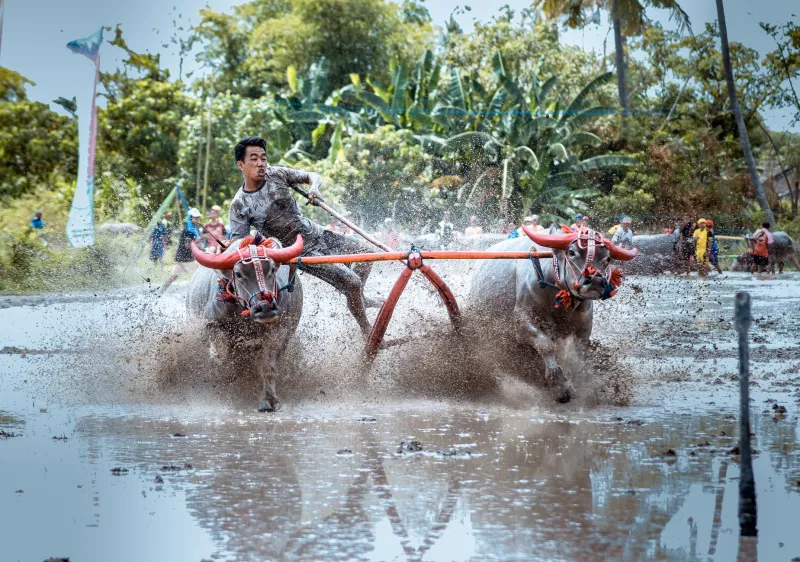
If you only know one thing about Pamekasan, it's probably karapan sapi — the bull racing tradition that turns the town into something between a county fair and a full-blown cultural spectacle every year. Two bulls, a wooden sled, a jockey, and a track that gets covered in about 100 meters of pure, chaotic speed. The whole thing is over in about ten seconds, but the lead-up — the grooming rituals, the ceremonial music, the crowd energy — lasts for days.
Karapan sapi isn't just entertainment. It's layered with meaning about status, community pride, and the relationship between Madurese people and their land. The bulls are treated like athletes, fed special diets, massaged, adorned. Winning isn't just bragging rights — it's honor for the whole family. For Indonesian-Americans returning to Pamekasan for the first time, watching a karapan sapi event often lands as one of those experiences that's genuinely hard to put into words afterward. It's visceral in a way that a museum exhibit simply cannot replicate.
The main season runs roughly from August through October, coinciding with the post-harvest period, and the regional finals draw crowds from across Madura and beyond. If you're planning a heritage trip, timing it around karapan sapi is the move.
A Batik Tradition That Plays by Its Own Rules
Here's something that surprises a lot of people: Madura has its own distinct batik tradition, and it looks almost nothing like the Javanese batik most Americans have seen. Madurese batik — and Pamekasan's version in particular — tends toward bold, saturated colors. Deep reds, bright oranges, stark blacks. The motifs lean geometric and floral, but with a directness that feels almost graphic by comparison to the more intricate Yogyakarta styles.
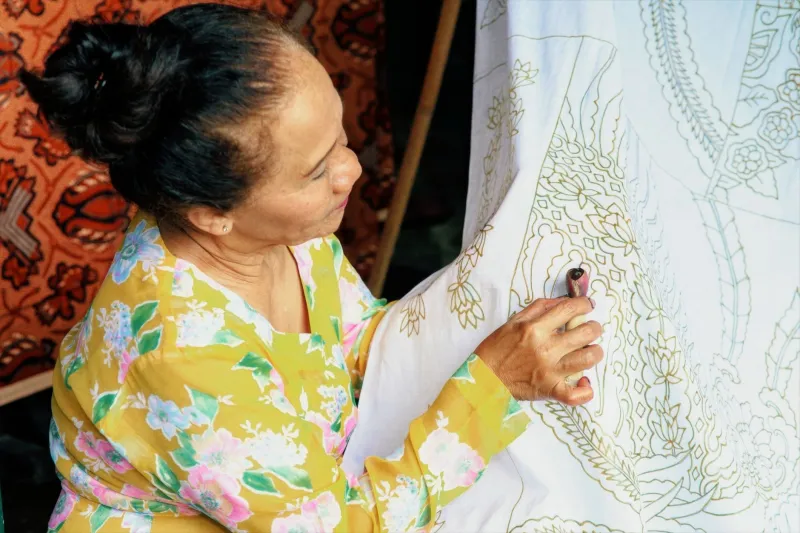
Batik Pamekasan is stamped and hand-drawn by artisans who've been doing this work for generations, and the craft is woven into the local economy in a real way. Walking through the batik market areas in Pamekasan, you'll find workshops where you can watch the process up close — the wax application, the dyeing, the scraping. A number of Indonesian-American visitors have been documenting these visits on social media, and the aesthetic has started catching the eye of people who had no idea this regional variation even existed.
For anyone interested in bringing something genuinely unique back home, a piece of Pamekasan batik isn't just a souvenir. It's a conversation starter with actual cultural weight behind it.
The Architecture That Tells a Story
Pamekasan's built environment is another thing that catches visitors off guard. Traditional Madurese architecture — characterized by elevated structures, ornate carved wooden facades, and a distinctive roof style that sweeps upward at the corners — gives the region a visual identity that's immediately recognizable once you know what you're looking at.
The tanean lanjhang, a traditional Madurese compound where multiple generations of a family live in a cluster of connected homes around a shared courtyard, is one of the more striking examples of how architecture and social structure reinforce each other. It's a physical expression of communal values — the idea that family isn't just the people in one house, but a whole network of relationships that deserves its own geography.
For Indonesian-Americans who grew up in American suburbs with the standard single-family-home setup, seeing a tanean lanjhang in person tends to hit differently. It reframes something abstract — "Indonesian community values" — into something you can literally walk through.
Why Indonesian-Americans Are Documenting the Journey
One of the more interesting cultural shifts happening right now is the rise of what you might call heritage content. Indonesian-Americans are filming their trips back to Pamekasan, posting the footage on YouTube and TikTok, and building real audiences around it. It's not travel vlogging exactly — it's more personal than that. It's people processing their own identity in real time, with a camera.
What's notable about the Pamekasan-specific content is how granular it gets. It's not "I visited Indonesia." It's "I found the village my grandmother left in 1972" or "I learned to make the specific sambal that my family always talked about." That level of specificity resonates — not just with other Madurese-Americans, but with the broader Indonesian-American community and, increasingly, with non-Indonesian viewers who are just drawn to the authenticity of it.
Several creators have built modest but dedicated followings just by documenting Pamekasan. And that content is looping back into American Indonesian communities, sparking conversations, reconnecting people with traditions they'd half-forgotten, and in some cases, inspiring people to make the trip themselves.
Bringing It Back Home
The other side of this story is what happens when people return. A growing number of Indonesian-Americans who've visited Pamekasan are coming back to their communities in the US with something specific to share. They're organizing karapan sapi watch parties during the racing season, streaming the events live. They're setting up batik workshops in community centers, using techniques they learned or observed firsthand. They're cooking Madurese food — soto Madura, nasi jagung, the distinct spice profiles that set Madurese cuisine apart from the broader Indonesian canon — and sharing it at potlucks and cultural events.
This is how living culture actually travels. Not through textbooks or museum installations, but through people who went somewhere, experienced something, and couldn't stop talking about it when they got home.
Pamekasan has always been there. It's always had the bull races, the batik, the architecture, the food. What's changed is that more people are paying attention — and more people have the tools to share what they find. If you've got Madurese roots, or you're just curious about the parts of Indonesian culture that don't make it onto the mainstream radar, this is a good time to start paying attention too.
We named this site after Pamekasan for a reason. It's not just a place — it's a reminder that the richest cultural stories are often the ones you have to go looking for.