Cloth That Speaks: Learning to Read the Stories Woven Into Indonesian Textiles
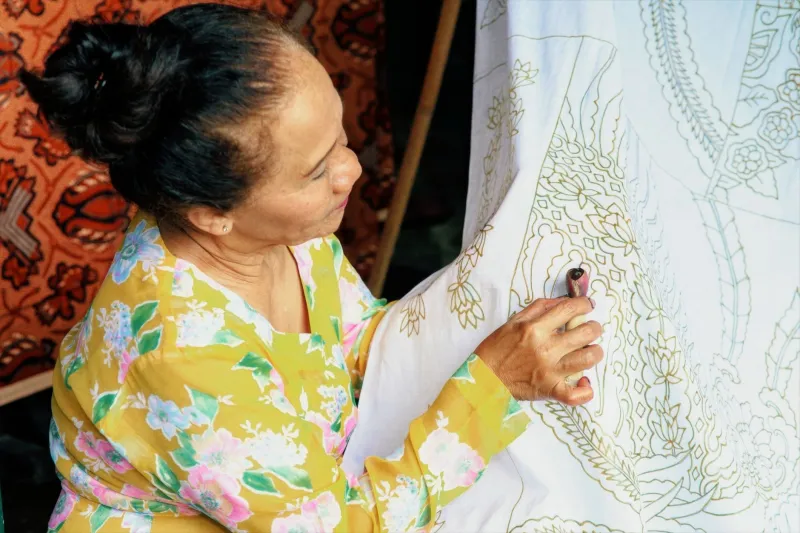
Somewhere in a closet in Dearborn, Michigan, there's a folded piece of batik that belonged to a grandmother who crossed an ocean and never came back to collect it. Her granddaughter, Sari, is 28 and works in marketing. She's had the cloth for six years. She always assumed it was decorative — something pretty to hang on a wall or drape over a chair when guests came over.
Then someone told her what the pattern meant. And everything changed.
"I had no idea I was holding something that basically described her whole life," Sari says. "The motif, the colors, even the way it was made — all of it was communicating something. I just didn't know the language."
That's the thing about Indonesian textiles. They're not just beautiful. They're literate. Every thread, every dye, every repeated symbol is part of a visual vocabulary that has been refined over centuries across thousands of islands. And for Indonesian-Americans who grew up disconnected from that tradition, learning to decode family heirlooms has become one of the most quietly profound ways to reconnect with where they came from.
A Living Language Made of Thread
Indonesia's textile traditions are staggering in their variety. Batik — the wax-resist dyeing technique most people in the US have heard of — is just one thread in a much larger tapestry. There's also tenun ikat, where threads are tied and dyed before weaving to create patterns that emerge almost like magic. There's songket, woven with gold or silver metallic threads in Sumatra and Bali. There's lurik from Central Java, with its simple striped geometry that carries surprisingly complex meaning.
Each region developed its own visual grammar. Coastal communities used different motifs than inland royal courts. Everyday cloth looked nothing like ceremonial cloth. And within those distinctions, individual patterns carried specific messages — about the wearer's social standing, their hometown, the occasion they were dressing for, and sometimes even their spiritual beliefs.
Textile scholar and community educator Dewi Hartanto, who teaches workshops on Indonesian cloth in the Los Angeles area, puts it plainly: "When you wear a sarong or a batik shirt, you're not just getting dressed. You're making a statement. The question is whether you know what you're saying."
The Big Three: Parang, Kawung, and Megamendung
For anyone starting to decode Indonesian textiles, three motifs come up again and again — and each one is a good entry point into the broader symbolic system.
Parang is one of the oldest and most recognizable batik patterns, a diagonal series of interlocking knife-blade shapes that flow continuously across the cloth. Historically, parang was reserved for Javanese royalty. Wearing it outside the palace was considered a serious breach of protocol. Today, that exclusivity has softened, but the pattern still carries connotations of strength, authority, and refinement. If your family heirloom features parang, there's a decent chance someone in your lineage was connected to Central Javanese aristocratic culture — or at least aspired to be.
Kawung is older still — geometric circles arranged in a grid, often described as resembling the cross-section of a palm fruit. It's found in ancient Javanese temple carvings, which tells you something about how long this motif has been around. Kawung symbolizes purity and clarity of thought. It was also associated with the highest levels of the royal court. Seeing kawung in a family piece often points toward Yogyakarta or Solo, the twin centers of Javanese batik culture.
Megamendung is a completely different visual world — billowing, cloud-like shapes in deep indigo and sky blue, stacked in layered gradients. This pattern comes from Cirebon, a coastal city in West Java where Chinese, Islamic, and Javanese artistic traditions collided and merged over centuries. The clouds are literally inspired by Chinese decorative motifs, adapted and transformed into something distinctly Cirebonese. Megamendung signals a connection to that particular coastal culture, and its layered colors are sometimes read as representing different levels of spiritual awareness.
These are just three examples. There are hundreds more, each tied to a specific place, time, and meaning.
Reading Your Own Heirlooms
For Indonesian-Americans in the US, the challenge isn't access to information — it's knowing where to start. Most people inheriting these textiles didn't grow up with anyone explaining the symbolism. The knowledge skipped a generation, or two, or three.
Reza, a 34-year-old engineer in the Bay Area, found his entry point through an unlikely source: a Facebook group dedicated to Indonesian batik collectors. He posted a photo of a cloth he'd inherited from his late father, and within hours, strangers were identifying the region, estimating the age, and explaining the significance of each motif.
"It felt like finding a decoder ring," he says. "Suddenly this thing that was just sitting in a drawer had a whole biography."
Dewi's workshops in LA take a similar approach, but with more hands-on guidance. Participants bring their own textiles and work through a series of questions: Where does the cloth appear to be from? What technique was used to make it? What are the dominant motifs, and what do they typically signify? Is this everyday cloth or ceremonial cloth — and how can you tell?
The answers don't always come quickly, and sometimes they raise more questions than they answer. But that's kind of the point. "The goal isn't necessarily to arrive at a definitive interpretation," Dewi says. "It's to build a relationship with the object. To start a conversation with your own history."
Why This Matters Right Now
There's something happening in Indonesian-American communities across the US that's hard to name precisely but easy to recognize once you see it. People are going back. Not necessarily to Indonesia itself — though some are doing that too — but back to the objects, the practices, and the knowledge systems that their families carried across the Pacific and then, in the business of building new lives, set aside.
Textiles are a particularly powerful vehicle for this kind of reconnection because they're tangible. You can hold them. You can wear them. You can lay them out on a table and point to specific details and ask questions. They're not abstract cultural concepts — they're things, with weight and texture and smell.
For Sari, the woman in Michigan who didn't know what her grandmother's batik was saying, the discovery set off a chain of conversations she'd never thought to have. She started calling older relatives. She found a batik workshop in her city run by a Javanese-American woman. She ordered two books on Indonesian textile history.
"I'm not suddenly an expert," she says, laughing. "But I feel like I'm finally in the conversation. Like I've been handed a language I didn't know I was supposed to learn."
The sarong in your grandmother's closet has been patient. It's been waiting for someone to ask what it means. Maybe it's time to start asking.