Roots Over Résumés: How Indonesian Ideas of Home Are Making Americans Question the Constant Move
There's a particular kind of exhaustion that comes with being a serial relocator. The third city in eight years. The storage unit that's basically a second apartment. The friendships that exist mostly in group chats because everyone keeps scattering. Americans have largely accepted this as the price of ambition — you go where the opportunity is, and you don't look back.
But spend some time talking to Indonesian-Americans about how they think about home, and something starts to crack in that logic.
What "Rumah" Actually Means
In Indonesian, the word rumah translates literally to "house" or "home." But culturally, it carries a weight that the English equivalent rarely does. A rumah isn't just a structure with a mortgage. It's a spiritual address. It's the place where your family's story lives, where the smell of your grandmother's cooking is baked into the walls, where neighbors know your name and your parents' names and probably your cousins' names too.
Rani Kusuma, 34, grew up in a Madurese household in East Java before her family relocated to Sacramento when she was twelve. She watched her parents make a deliberate choice in their new country: they were going to stay. Not because better opportunities didn't exist elsewhere, but because they understood something about what leaving costs.
"My dad always said, 'We already moved once. We're not moving again,'" Rani recalls. "And at the time I thought that was just stubbornness. Now I think it was wisdom."
Her parents bought a house in the same Sacramento neighborhood in 1998 and are still there. Rani lives four blocks away. Her brother is two miles down the road. Three Indonesian families from their original community are within walking distance.
"We built something," she says. "You can't build that if you keep leaving."
The Multi-Generational Compound and the American Floor Plan
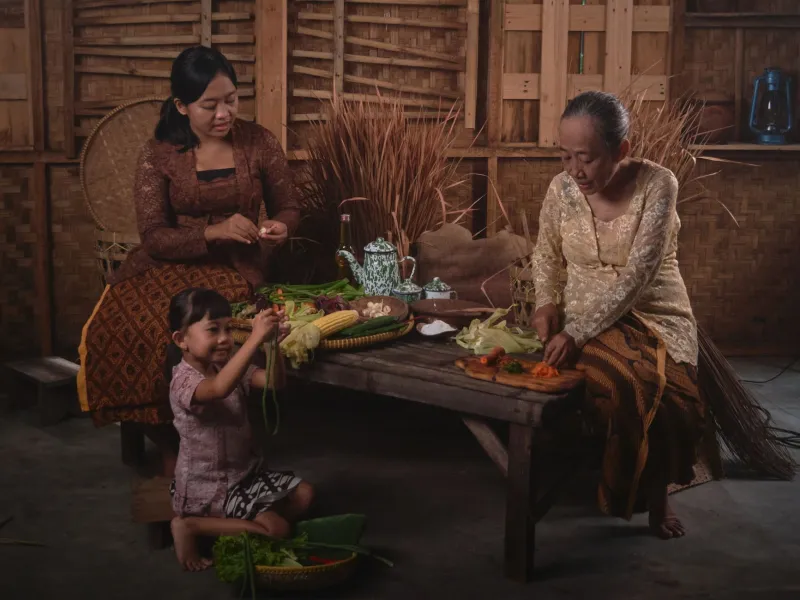
One of the more striking features of traditional Indonesian domestic life — particularly in places like Madura and Central Java — is the rumah compound. Extended family members don't just live nearby; they often live within the same walled property, sharing a courtyard, a well, a kitchen garden. Grandparents, aunts, uncles, and cousins occupy separate structures but exist within a shared ecosystem.
This is almost the opposite of the American dream's standard blueprint: the single-family home, the nuclear household, the deliberate separation of generations into different zip codes.
Hendra Wibowo, a 41-year-old architect based in the Chicago suburbs, has spent the last several years designing homes for Indonesian-American clients who want something the standard housing market doesn't really offer — space for multiple generations, shared outdoor areas, architecture that encourages staying together rather than spreading out.
"My clients aren't looking for the biggest house," Hendra says. "They're looking for the right configuration. A mother-in-law suite isn't enough. They want a setup where grandma isn't hidden in a back bedroom — she's part of the flow of the house."
He's noticed a parallel interest from non-Indonesian clients too, particularly younger Americans who watched their parents age alone in big empty houses and decided they wanted something different.
"The pandemic shifted a lot of people," Hendra notes. "When you're suddenly stuck at home, you realize pretty fast whether your home actually works for your life or not."
The Career Mobility Trap
The American corporate culture of relocation is so normalized that it barely gets questioned. Take the promotion, move to the new city, restart your social life, find new doctors, new dentists, new everything. Repeat. The assumption embedded in this cycle is that career advancement is worth whatever personal infrastructure you dismantle to chase it.
But researchers studying social capital — the dense web of relationships, trust, and community investment that makes neighborhoods function — have started sounding alarms. The more Americans move, the harder it becomes to build the kind of deep local ties that actually make life feel meaningful. You can have a LinkedIn profile full of impressive cities and still feel profoundly unmoored.
Dewi Hartanto, a 38-year-old community organizer in Minneapolis, lived that cycle in her twenties. Marketing job in Austin, then a better offer in Denver, then a startup in Seattle. By the time she hit 32, she had a strong résumé and almost no one she could call at midnight if something went wrong.
"I had colleagues everywhere and friends nowhere," she says flatly. "That's not a life. That's a LinkedIn strategy."
She eventually moved back to Minneapolis, where she had cousins and an Indonesian community that had been quietly building itself for years. She took a pay cut. She doesn't regret it.
"In my family's culture, you invest in where you are. You don't treat your neighborhood like a temporary rental," Dewi says. "When you know you're staying, you actually show up. You join things. You care about the school board because your kids are going to that school for twelve years."
Staying as Resistance
There's a quiet radicalism in choosing to stay. In a culture that equates movement with ambition and stillness with stagnation, the decision to plant yourself — to say this is my place and I'm going to tend it — can feel countercultural.
For many Indonesian-Americans, that choice is also an act of cultural continuity. The traditions that give rumah its meaning — the communal meals, the neighborhood ceremonies, the informal networks of mutual aid — only function when people stick around long enough to participate in them.
"You can't have gotong royong if everyone's always leaving," says Rani, referencing the Indonesian concept of communal cooperation. "That spirit only works when people are committed to the same place."
And that commitment, it turns out, has measurable payoffs. Studies on community wellbeing consistently show that long-term residents report higher levels of social trust, stronger support networks, and greater civic engagement than frequent movers. Staying, it seems, is its own kind of investment — one that pays dividends in belonging rather than salary bumps.
What This Looks Like in Practice
None of this means Indonesian-American families are uniformly opposed to moving or that geographic flexibility is inherently bad. Life is complicated. Opportunities are real. But what the rumah framework offers is a different question to ask before packing the boxes: What am I leaving behind, and is what I'm chasing actually worth it?
For Hendra, it's meant building a practice around designing homes that encourage people to commit to a place. For Dewi, it's meant rebuilding a community from scratch — slowly, stubbornly, with intention. For Rani, it's meant watching her kids grow up knowing their grandparents not as voices on a video call but as people who show up for dinner on Tuesdays.
"My daughter asked me the other day why we don't move like her friend's family," Rani says. "And I told her: because this is where our story is. You don't leave your story."
That's not a real estate strategy. That's a philosophy. And in a country that's been treating mobility as a virtue for so long it forgot to ask why, it might be exactly the kind of rethinking we need.