Grandma Stays Home: What Pamekasan's Family Culture Is Teaching Americans About Growing Old Together
There's a moment that Siti Rahayu, 38, remembers clearly. She was sitting in a sterile-smelling hallway of a senior living facility in suburban New Jersey, touring it for her mother-in-law, when something just didn't feel right. Not wrong, exactly — the place was clean, the staff were kind — but deeply, quietly off.
"I kept thinking: this is not something my family does," she says. "In Pamekasan, where my mother-in-law grew up, you don't send your parents somewhere. They're just... there. In the house. At the table. In the middle of everything."
Siti and her husband ended up converting their garage into a small apartment instead. Her mother-in-law moved in six months later. And while the logistics were messy and the adjustment was real, Siti says she hasn't looked back.
She's not alone in this pivot.
The American Eldercare Problem Nobody Wants to Talk About
The numbers are hard to ignore. The U.S. is home to roughly 1.3 million nursing home residents, and the average annual cost of a private room clocks in at over $100,000. For assisted living, you're looking at $54,000 or more per year. Meanwhile, studies consistently show that loneliness and social isolation are major drivers of cognitive decline in older adults — and institutional settings, however well-run, often struggle to replicate the kind of constant, casual human contact that keeps aging minds and bodies sharp.
Americans are starting to feel the squeeze from every direction: financially, emotionally, logistically. And some are beginning to ask whether the whole model needs rethinking.
Enter the multigenerational household — something that's been standard practice in places like Pamekasan, a mid-sized city on the island of Madura in East Java, for as long as anyone can remember.
What Multigenerational Living Actually Looks Like in Pamekasan
In Pamekasan, the concept of aging in place isn't a trend or a policy initiative. It's just life. Grandparents, parents, children, and sometimes even aunts and uncles share compounds or adjacent homes, moving fluidly between spaces, meals, and responsibilities. Elders aren't sidelined — they're consulted, involved, and genuinely present in the rhythm of daily family life.
This structure is partly cultural, rooted in Madurese values around family loyalty and communal responsibility. But it's also practical. Grandparents provide childcare. Adult children manage household decisions. Teenagers run errands. Everyone contributes something, and everyone receives something in return. The exchange isn't transactional so much as organic — it's just how things work.
Dr. Yusuf Hakim, a sociologist who studies Madurese diaspora communities in the U.S., describes it as a "relational economy of care." "In Pamekasan, care is not a service you purchase," he explains. "It's a relationship you maintain. The elder is not a burden to be managed — they are a resource, a source of memory and wisdom, and they are treated as such."
Indonesian-American Families Rewriting the Playbook
Across the U.S., Indonesian-American families — particularly those with roots in Madura and East Java — are quietly experimenting with ways to bring this model into American life. It doesn't always look identical to what it does back home. American zoning laws, housing costs, and work schedules create real constraints. But the spirit of it is translating in surprising ways.
In Houston, the Wibowo family bought a duplex specifically so that the grandparents could live next door rather than across town. "We eat dinner together four nights a week," says Dewi Wibowo, 41. "My kids know their grandparents in a way I didn't know mine until I was an adult. That's worth a lot."
In Minneapolis, Farid Santoso and his siblings rotated caregiving for their father after his stroke, rather than moving him to a rehabilitation facility. "It was hard," Farid admits. "But my dad recovered faster than his doctors expected. They said the stimulation of being around family — the noise, the conversations, the grandkids — probably made a real difference."
These aren't isolated anecdotes. Research increasingly backs up what Pamekasan families have practiced intuitively for generations. A 2020 study published in The Gerontologist found that older adults living with family members reported significantly higher levels of life satisfaction and lower rates of depression than those in institutional care. Another study from the University of Southern California found that multigenerational households actually reduce financial stress across the board — not just for elders, but for younger family members too.
The Emotional Math Nobody Talks About
Beyond the economics, there's something harder to quantify that Indonesian-American families keep coming back to when they describe their choices: guilt, and its absence.
"When you grow up in a culture where caring for your parents is expected — not as a burden but as an honor — the idea of placing them in a facility feels like a kind of failure," says Siti. "I'm not judging anyone who makes that choice. I understand why people do. But for our family, it wasn't something we could feel good about."
That emotional calculus is increasingly resonating with non-Indonesian Americans too. As the Baby Boomer generation ages and their Gen X and Millennial children face the reality of eldercare, many are reevaluating assumptions they inherited without question.
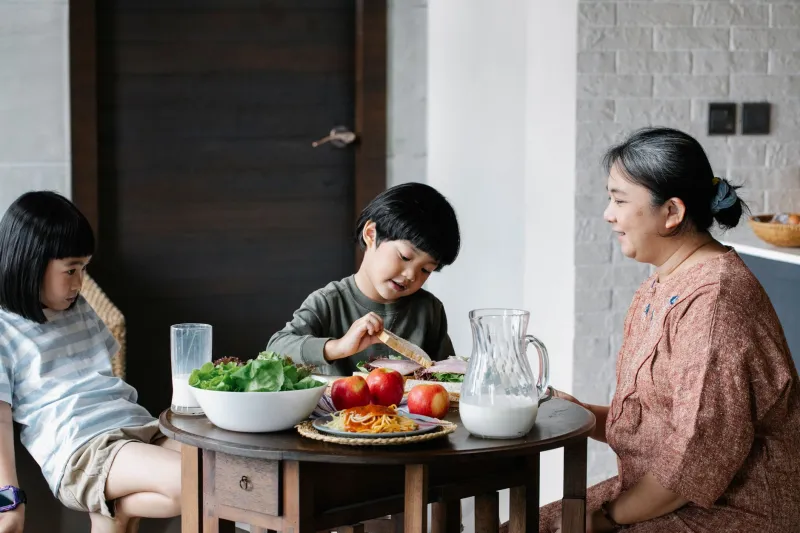
Social media has played a role. TikTok and Instagram are full of content from Indonesian-American creators sharing glimpses of multigenerational home life — grandparents teaching grandchildren to cook, elders at the center of holiday celebrations, three generations crammed happily around a single kitchen table. For American viewers raised on a cultural script that prizes independence and privacy above almost everything else, it can feel quietly revolutionary.
Making It Work in America
Of course, transplanting a cultural model across an ocean isn't simple. American homes aren't always designed for multiple generations. Zoning laws can complicate accessory dwelling units. And family dynamics that work beautifully in theory can get complicated fast when everyone's under the same roof.
But there are practical frameworks emerging. Architects and home designers are increasingly fielding requests for "in-law suites" and multigenerational floor plans. Some states have updated zoning codes to make accessory dwelling units easier to build. And family therapists who work with immigrant communities are developing tools to help families navigate the cultural negotiation that multigenerational living requires.
Dewi Wibowo's advice is straightforward: "Set expectations early, give everyone privacy, and eat together as often as you can. The meals are what hold everything together."
Siti Rahayu agrees. Her mother-in-law, now 74, has become the unofficial heart of their household — the one who knows where everything is, who remembers the old recipes, who the kids run to when they're upset. "She's not in a room somewhere being cared for," Siti says. "She's in the middle of our lives. That's the difference."
A Different Way of Thinking About the End of Life
What Pamekasan's model ultimately offers isn't just a housing solution or a cost-cutting strategy. It's a fundamentally different framework for thinking about what it means to grow old — one where aging isn't a problem to be managed or a stage to be warehoused, but a phase of life to be integrated fully into the family's ongoing story.
America is still figuring out what that could look like at scale. But in living rooms and converted garages and duplex units from Houston to Minneapolis, some families are already running the experiment.
And from where Siti is sitting — at her kitchen table, her mother-in-law across from her, her kids doing homework in the next room — it's going pretty well.